
Alina Goncharova Morawski
Jul 27, 2023
As part of our mission to see as much of Alaska as possible in our first year here, we set our sights on one of its most remote frontiers: Adak. The town sits at the western tip of the Aleutian chain, a volcanic arc born of colliding tectonic plates. It lies 1,200 miles southwest of Anchorage, farther west than Hawaii, where the Bering Sea meets the Pacific in a restless embrace. For a place that feels so far off the map, Adak is surprisingly reachable. Alaska Airlines lands a 737 here twice a week. These flights, rarely more than a third full, feel like private charters across the open ocean.

Reaching this distant outpost requires a trick of modern travel economics: pay with miles, not dollars. A round trip fare can cost upward of $1100 in cash but just 12,500 miles, about $370 if you bought them outright. At first, the cost seemed like an error, but within hours our midsummer flights were booked, securing our passage to one of the Aleutians’ most remote outposts.

Adak today is a place where silence hangs in the wind. The island's Cold War past lingers in the skeletons of the neighborhoods and the shells of a theatre, a swimming pool, and gym. Built to house 6,000 military personnel, these structures now watch over just a few dozen residents. Some, like the friendly and talkative local we met is at once the grocer, TSA agent, and librarian. Though the census lists 80 residents, the islanders say only 20-30 live here year-round. Their stories, of arriving, adapting, and sometimes simply enduring, hint at what it means live on a windswept rock halfway between Tokyo and Seattle.


Human history runs deeper still. For centuries, the Unangax̂ (Aleut) people lived on Adak. By the 1830s, villages were abandoned under pressure from Russian colonization, and the Unangax̂ were forcibly relocated to settlements on Kodiak, Sitka, and the Pribilofs. More than a century later, the island transformed again, this time under American colonization. Naval stations bristled with radar towers and submarine surveillance posts. When the U.S. military withdrew in the 1990s, Adak’s population collapsed. In 2004, the Aleut Corporation, an Alaska Native Regional Corporation, took ownership of nearly 50,000 acres, including many abandoned buildings. Today, backcountry permits must be secured from the corporation, a process that often begins at the airport when locals greet new arrivals.

We stepped off the plane, eager to hike, only to wait nearly an hour for our bags. With fewer than three dozen residents year-round, airport operations move at their own pace. The delay offered a chance to meet fellow travelers: hunters, biologists, and wanderers, each drawn here by the island’s rare solitude.
For those who venture here, the choice is stark: wander through echoes of a militarized past, or hike into the lush, wet landscape, where caribou dart over the windswept, treeless hills, and storms roll in without warning. Either way, Adak offers something increasingly rare. A place where human footprints fade, while nature and history endure.


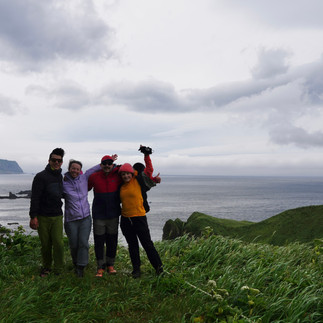
From left to right: 1. The Welcome to Adak sign just outside of the airport. 2. The only gas station in town. 3. Jackson, Alina, Kate, Adam, photo taken by our new friend Buka.
We almost arrive without our stove. Alaska Airlines officially allows camp stoves, but the Anchorage staff weren't sure. After a confusing exchange, we pulled it from our checked bag, then slipped it into our carry-on, which TSA let us through with. Once our pack arrived, we walked past the Adak Island sign, snapped a group selfie, and set out toward the lone gas station. We topped off our fuel canister, and began toward Finger Bay. A few miles in, a rented pickup stopped. Inside were three men: two air force pilots and their local guide, stranded on Adak for weeks, waiting for a weather window to continue their journey, flying a plane from Japan to Texas. They offered us a ride, spilling stories of a different kind of island life, patience, and survival. As they dropped us off, we wished them luck, and hoped we'd see them again at the island's one bar. Encounters like this warm the heart far from anywhere.


The terrain was immediately immersive. Before reaching Finger Bay, the terrain became a spongy maze of moss and wet meadows. Each step sank slightly revealing hidden puddles. We spotted translucent jellyfish dancing in the water, their delicate bodies illuminated by the Aleutian sunlight. Windswept hills gave way to carpets of wildflowers, their colors startling against the muted greens. The chill of the Pacific air and the constant drizzle seeped through our layers, a reminder that Adak resists easy passage.

By Sunday morning, rain pattered against our tent. Now enveloped in wetness, in the form of rain, fog, and bog, we packed out. Hiking toward Exploration Cove, fog rolled and peeled back to reveal distant islands, and the ground was a quilt of lush, spongy grass doted with wildflowers. I began collecting a bouquet: one stem of every kind. At Exploration Cove, finding dry ground was nearly impossible. Sleeping pads went on the least-wet spots, socks came off, and we tried to air out our feet in the wet air. Then movement caught our eye. Caribou, skittish and graceful, darted over a ridge, and this rare sight made the soggy discomfort feel worthwhile. Caribou, not native to Adak, were introduced in the mid-20th century to provide a game population for hunters. Today, herds roam the windswept hills, a curious blend of wild presence and human management that colors the island’s rugged backcountry with movement and life.

Seeking higher, drier ground, we pushed onto Lake Bonnie Rose. Sunshine greeted us atop the ascent, along with the infamous Adak winds. Later, a local chuckled when we mentioned them. "Oh, you haven't experience the winds of Adak yet." Winds here sweep down from the North Pacific with regularity. Sustained gusts of 30–40 mph are common, while storms can whip air over 100 mph, shaping both the landscape and the lives of those who live here.
Out of dry clothes we headed in to town to dry off and rest in a once abandoned house, now used by a local company as rental stays. In town, there's an old abandoned McDonalds, and rows and rows of houses left in various stages of disrepair.





It came time to experience a different side of Adak. The island's geothermal quirks include a scattering of hot springs. Fragile pools reshaped each season by erosion and storms rolling in from the North Pacific. Reaching Adak's hot springs is less a leisurely stroll and more a small expedition. The route demands careful timing with the tides and a willingness to scramble. From the trailhead, the path drops sharply down a hillside where a weathered rope dangles to aid your descent. At low tide, the shoreline route becomes passable, and the search begins. There are ropes strung curiously from ledges far above. Remnants of previous hikers' attempts to tame the terrain swaying in the Bering wind, though many seem suspended out of reach.


We wandered and scrambled, testing the temperature of shallow pools with our hands, unsure if we had stumbled upon the right spot or just another seep of seawater. The endless search, however, did reward us with a spiny surprise. Clusters of sea urchins clung to the tidal rocks, their orange roe a delicacy. Decades ago, these grazers stripped much of Adak’s kelp forests, a dramatic shift in the underwater ecosystem. A quiet reminder of the island’s delicate balance between human influence and wild resilience.


At last, we discovered a modest basin of lukewarm water. Not a spa, but a window into Adak's restless geology. Still, after the scramble and suspense, lowering into that mineral-rich pool with friends felt like triumph. The hot springs are not the sort of place you travel to Adak for, nor are they likely to lure casual bathers. The ones we found were barely warm enough to fend off the cold winds blowing off the Bering. But they offer something rarer than comfort. The trill of discovery in a place where few paths are certain, and where adventure lies in the not-knowing.
Adak is a place of contradictions: eerie ruins and lush wildflowers, solitude and kindness, endless wet bogs and brilliant sunlight. It’s too small to be a world of its own, yet too vast to grasp in a single trip. Five days were just enough to explore, to be awed, and to know we’d return.

Animals Seen:
⁃ Caribou
⁃ Seals
⁃ Ptarmigan
⁃ Bald Eagles
⁃ Otters
⁃ Mergansers
⁃ Black oyster catchers
Flowers Seen:
⁃ Common cowparsnip
⁃ White bog orchid
⁃ Yellow Rattle
⁃ Nootka Lupine
⁃ Common Yarrow
⁃ Seaside Pea
⁃ Twin flower
⁃ Key Flower (marsh Orchid)
⁃ whorled lousewort
⁃ Beach-head Iris
⁃ Kamchatka Rhododendron
⁃ Wandering Daisy
⁃ Chocolate lily / Rice Root
⁃ Swedish cornel
⁃ Calthaleaf Avens
⁃ Orange hawkweed
⁃ Seabeach groundsel
Resources:
Adak Island, Far Out in the Bering Sea, May Be Where the Wind Begins
Alaska Airlines officially allows camp stoves, however not reliably